
The importance of structured data on your website
What is it and how do you add it?
by Monique Maessen-Demoet, owner at Demoet grahic design
Picture this: someone types “good graphic designer for my business” into ChatGPT, and your website has been sitting neatly on the first page of Google for years. Yet your name never comes up. Not because your work isn’t good, and not because your site isn’t found by Google. The problem lies somewhere else: AI tools like ChatGPT, Gemini and Perplexity read your website differently than Google does. They look for clear, machine-readable clues about who you are, what you do and who you work for. Without those clues, an AI tool often skips your website completely, even if everything is actually there.
Those clues are called structured data. It sounds technical, and that’s exactly why many business owners leave it alone. Yet it is one of the simplest things you can do to help both Google and AI tools understand your website. In this blog I explain what structured data actually is, why you need it, what happens if you don’t have it, how to add it, and which risks come with it.
In short, structured data is a piece of code on your website that tells search engines and AI tools, in a fixed and recognisable format, what your page is about: who you are, what business you run, which services you offer or which questions you answer. Search engines and AI tools read that code instantly and use it to display, cite or recommend your content.
What is structured data exactly?
Structured data is standardised code you add to the programming language of your website so that search engines and AI systems understand exactly what a page is about. Where a visitor simply reads “Demoet grafische vormgeving, logos and branding from €490”, a search engine without structured data only reads loose text. With structured data, it literally states: this is a business, this is the service, this is the price, this is the type of organisation.
The international standard for this is called Schema.org. It’s a joint initiative by Google, Bing, Yahoo and Yandex, which agreed on a shared vocabulary of labels, known as schemas, for businesses, products, articles, reviews, frequently asked questions and much more. Google itself recommends writing structured data in JSON-LD format, because it’s the easiest to maintain and doesn’t interfere with the rest of your website. You can find the official explanation on Google Search Central.
You’ve probably come across structured data already, without realising it. Search Google for a restaurant, and you sometimes see the opening hours, address and a star rating right away, before you even click the link. That extra information is there thanks to structured data: that page tells Google exactly which snippet of text is the address, which is the opening hours, and which is the rating.
What is structured data for, and why do you need it
Structured data exists to make your website readable for machines, not just for people. That might sound unnecessary, since your website already looks fine to a visitor. But search engines and AI tools don’t read a beautifully designed page with a logo and a nice photo. They read code. And in that code, it’s often not obvious to them whether “Monique” is a person, a business name, or just a word that happens to appear on the page.
Structured data provides that clarity. You state plainly: this is a business with this name, this address and this phone number. This is a service at this price. This is a question with this answer. The more explicit you are, the smaller the chance that a search engine or AI tool misreads your page, or worse, skips it entirely.
There are a few concrete benefits business owners notice right away:
- Your business details, such as address, phone number and opening hours, can appear directly in the search result, before anyone even clicks your link
- If you publish a blog with a step-by-step guide or frequently asked questions, Google can display it as a clear list among the search results
- If a potential client asks ChatGPT or Gemini for a recommendation in your field, there’s a better chance your business gets mentioned
- A search result with extra information stands out more among the other results, which means more people click on it
Curious how this connects to visibility in AI answers? I went deeper into that in my blog how your website ends up in AI search results.
What happens if you don’t have structured data on your website?
Without structured data, your website doesn’t lose anything visible to a regular visitor, but it does lose something invisible to search engines and AI tools. Your page stays online and remains perfectly readable to people. The problem sits in the layer behind it.
Search engines then have to guess what your page is about, based on loose text, headings and images. That usually works reasonably well, but not perfectly. AI tools have an even harder time. They build their answers from sources they can interpret quickly and with confidence. A page without clear, structured clues simply gets skipped in favour of a competitor who does have it in order.
In practice, I see this happen to small business owners whose content and offering are perfectly fine, yet who remain invisible in AI answers. Not because their work isn’t good enough, but because their website is simply impossible for a machine to decipher. That’s a shame, because it’s exactly the sole traders and small businesses with a smaller marketing budget who need this free form of visibility the most.
How do you add structured data to your website?
This snippet tells exactly who you are, how you can be reached and what type of organisation you run. There are dozens of schemas like this: for articles, products, reviews, frequently asked questions, events and more. Which schema you need depends on the type of page.
There are two ways to add this to a WordPress website.
1. The first way is through an SEO plugin such as Yoast SEO. The free version of Yoast automatically generates a basic schema for your organisation, such as your business name, address and logo. For more extensive schemas, such as one for frequently asked questions or specific products, the free version doesn’t offer enough functionality. For that you need something extra.
2. The second way is adding JSON-LD yourself with a plugin such as WPCode Lite. This lets you place your own piece of code on your website easily, without having to work in your theme files. This is the way to add the specific schemas your SEO plugin doesn’t offer by default, such as a schema for frequently asked questions or a product overview.
To check whether everything is set up correctly, you can use two tools, and they don’t do the same thing. Google’s Rich Results Test shows whether your structured data qualifies for one of the rich results Google itself supports, such as star ratings or frequently asked questions. The Schema Markup Validator checks your code against the full Schema.org standard, including the schemas Google doesn’t use for rich results but that AI tools can still read. Want to know mainly whether you qualify for a more eye-catching Google search result? Use the Rich Results Test. Want to confirm your structured data is fully correct and complete, with AI tools in mind too? The Schema Markup Validator is the better choice.
Types of structured data and their purposes
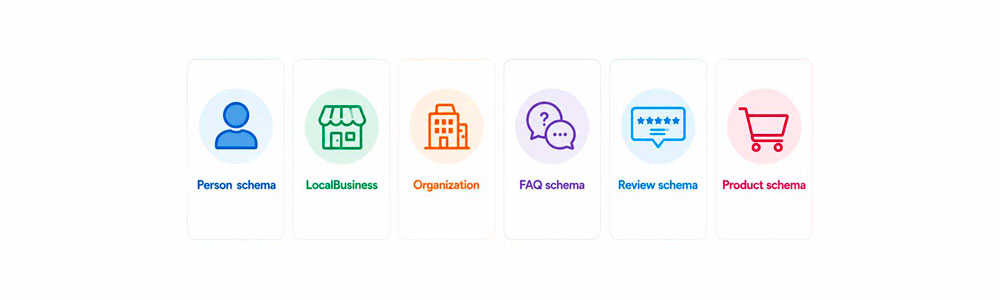
There are several types of structured data, such as:
- Person schema: provides information about a person, such as name, profession, photo, and social profiles. This is used by coaches, consultants, etc.
- LocalBusiness: provides information about a local business, such as address, opening hours, phone number, email, and reviews. Examples include restaurants, shops, or hair salons.
- Organization: provides information about an online business or organization, such as name, logo, contact details, and social profiles. Examples include online businesses, institutions, or brands.
- FAQ schema: displays frequently asked questions and answers on your website. It helps increase visibility in Google through expandable FAQs.
- Review schema: displays ratings and reviews, including star ratings and reviewer details. Examples include customer reviews, testimonials, or product reviews.
- Product schema: provides information about a product, such as price, availability, brand, and reviews. Examples include physical products, software, or services.
What are the risks of adding structured data?
Adding structured data is generally safe, but there are a few risks worth keeping in mind.
The biggest risk is a plugin conflict. If you have several SEO or schema plugins active at the same time, they sometimes both generate the same type of schema. The result is duplicate or conflicting code on the same page, leaving Google unsure which information is correct. I regularly see this on websites I didn’t build myself: a schema plugin is active alongside Yoast, while Yoast already handles this automatically.
A second risk is incorrect or outdated information in your schema. If you enter the wrong phone number, old opening hours or a service you no longer offer, Google or an AI tool simply takes over that incorrect information. That’s worse than having no structured data at all, because you’re actively spreading incorrect information.
A third risk is exaggerated or misleading schemas, for example a schema with star ratings that don’t match your actual reviews. Google is increasingly strict about this and can remove a page from rich search results if it detects misuse.
These risks are easy to manage with a bit of attention: use one schema solution per website, keep your information up to date, and regularly check via Google’s testing tool that everything still checks out.
Can you add structured data yourself, or is it better to outsource it?
My advice is clear: for ninety-nine percent of business owners, I’d advise against adding structured data yourself, unless you have technical knowledge of your own. A wrongly filled-in schema or a plugin conflict is often something you won’t notice yourself, while it can genuinely damage your visibility in Google and with AI tools. So it’s better to leave this to a website builder who knows what they’re doing.
When can you do it yourself?
- You have a simple WordPress website with a good SEO plugin
- You have technical knowledge of code and schemas yourself
- You only need a basic schema, such as your business name and address
- You take the time to check the result with a validation tool
When is it better to outsource it?
- You want to add multiple or specific schemas, such as for services or frequently asked questions
- You have no technical background and want to avoid the risk of mistakes
- You want to prevent plugin conflicts from happening
- You want it done right the first time, without spending your own time on it
What does structured data have to do with AI?
Structured data is one of the most important building blocks for being found and cited by AI tools. While Google has relied on structured data for years to show rich search results, AI tools like ChatGPT, Gemini and Perplexity take this a step further. They build their answers from multiple sources, and prefer pages whose content can be interpreted quickly and without doubt.
A page with clear structured data essentially says: here is a business, this is the service, this is the price, this is the location. An AI tool doesn’t have to guess and can take that information straight into an answer for the user. A page without these clues gets skipped more often, even if the content itself is perfectly fine.
This doesn’t mean structured data guarantees visibility in AI answers. But it is one of the clearest levers you can pull as a business owner yourself, alongside clear copy, up-to-date business details and a well-organised website structure.
Conclusion
Google AI and ChatGPT increasingly decide who gets found online. Not as a link at the bottom of a list, but as the direct answer at the top. Every week you wait, your competitor builds up more authority with AI tools. A customer who gets an AI answer and clicks straight through to a competitor is a customer you’ll never see. That’s not a future scenario, it’s happening today.
Structured data is one of the most important ways to respond to that. It helps Google understand your page better, increases your chances of appearing in rich search results, and allows AI tools like ChatGPT and Gemini to cite your content instead of skipping it. My advice: have structured data added by a web designer who knows what they’re doing, so it’s done correctly and completely. Curious where your own website currently stands? It’s easy to find out.
Frequently asked questions about structured data
Is structured data the same as SEO?
Does structured data slow down my website?
No, a properly placed schema in JSON-LD format has virtually no impact on your website’s loading time. It’s a small piece of code that sits separately from the visible content of your page.
Do I need structured data if I already rank well in Google?
Yes. Ranking well in Google says nothing about how well AI tools understand your website, and that has become just as important. More and more people ask their questions directly to ChatGPT or Gemini instead of searching through Google. Structured data is a must today for business owners who want to be found by AI, even if your Google rankings already look great.
What types of structured data are there?
Get started with structured data
Want a new website built? Take a look at my web design page or feel free to get in touch directly (0031 6 4821 6537). I’m happy to help.
Demoet graphic design helps business owners and private clients with web design, graphic design and interior design. With more than 30 years of experience and many satisfied clients, a trusted address.
More blogs

How do you choose a good web designer?
How do you choose a good web designer?by Monique Maessen-Demoet, owner at Demoet grahic designThese are the five things I would check myself. You need a website. Maybe your first, maybe your third...

Current interior design styles
Current interior design stylesby Monique Maessen-Demoet, owner at Demoet grahic designInterior design trends are constantly changing. What was modern five years ago can feel dated now. However,...

The 7 most common mistakes in logo design
The 7 most common mistakes in logo designby Monique Maessen-Demoet, owner at Demoet grahic designAs a graphic designer, I see it often: entrepreneurs who rush to create a logo without properly...
Want to share this blog?