
Why have a business card designed?
by Monique Maessen-Demoet, graphic designer at Demoet grahic design
You're at a networking drink. You spend twenty minutes talking to someone who is exactly your target audience. There's a click, there's interest. And then... you both have to fumble with your phones to look up LinkedIn profiles, type names wrong, and hope the connection doesn't drop. The click is already half gone before your name has even been properly remembered.
Sound familiar? Then you know exactly why a business card in 2026 isn't nostalgia, but simply a smart business choice. I see it in practice: many starting entrepreneurs invest in a beautiful website and active social media, but when it comes to a business card, they think: "I don't really need that anymore, do I?" They head to their first networking event full of enthusiasm and come home with a handy collection of other people's cards, but nothing of their own to hand out.
A professional business card is one of the cheapest and most effective ways to present yourself. Not because of the card itself, but because of what it radiates: that you're serious, that you stand for something, and that you take the trouble to make a good impression. In this blog I'll explain why a well-designed business card is still worth its money and what to pay attention to when having one made.
Short answer: having a business card designed pays off, because it leaves a tangible, personal impression that digital contact cannot match. For €75, you get a design that lasts for years and aligns with your brand identity.
What does a business card actually do for your business?
As an entrepreneur, you're constantly busy making yourself known. You share posts on social media, you send emails, you work on your website. Those are all digital touchpoints. But you know what digital can never truly replicate? The moment someone holds something of yours in their hands.
A business card is tangible. It takes up a spot on someone's desk, in their wallet, or on the fridge in their office kitchen. And every time someone sees it, they think of you. That's a kind of presence a LinkedIn profile simply doesn't have. A connection request gets dismissed or forgotten. A beautiful card stays.
Research shows that 39 percent of people decide not to do business with an entrepreneur who has a cheap or sloppy business card. That might seem unfair, but it tells you exactly how people work: they judge the quality of your work based on what they see from you first. A poor card creates the impression that you also don't take the details seriously in your craft. And that's not what you want.
First impression: the three seconds that count
You've probably heard that people form a judgment within a few seconds. The same applies to a business card. In the three seconds someone looks at your card, they see your name, your logo, the paper weight, the colors, and the fonts. All those elements together say something about who you are as an entrepreneur.
A card on 350 or 400 gram paper with a sleek design that matches your brand identity feels different from a standard template that looks like 50,000 other cards. One card gets kept in the wallet. The other ends up unnoticed in the trash. There's no getting around it: the card is a silent representative of your business, long after the conversation is over.
Why doesn't online networking replace the business card?
Of course, LinkedIn exists. QR codes exist. Contact pages exist. And yet the business card holds its own place, precisely because we do more and more online. At an event, a trade show, or a networking gathering, you want to be able to switch smoothly. You don't want to be searching on your phone while in conversation, checking your wifi connection, or hoping the other person types your name correctly.
Handing over a card is a fluid gesture. It fits a conversation already underway and doesn't break the contact. What's more: not everyone who is a potential client for you is active on LinkedIn or has the habit of connecting online right after meeting someone. Especially among older entrepreneurs, local shop owners, or people who simply aren't very digitally minded, a physical card is the most accessible way to leave your details behind.
And there's something else. A business card can be passed along. Someone who has your card in their wallet can easily show it or give it to someone else. You don't pass on a LinkedIn profile so easily. Word-of-mouth is the best source of new assignments for many freelancers, and a card is the physical extension of that principle.
Wat is het voordeel van tastbaar contact?
There's something in human nature that gives tangible things more value than digital ones. When you give someone your card, that's also a small ritual: you introduce yourself, you give something of yourself along with it. That moment gets registered, unconsciously, as a more meaningful contact than a connection request still sitting unread in someone's inbox weeks later.
I've had clients tell me they've kept a card of mine for years, simply because it looks nice. They didn't even know they'd ever buy something from me. But when the moment came, they knew exactly who to call. That's the quiet power of a well-designed card: it keeps working even when you're not there.
What should a good business card meet?
A business card that works is more than your name and phone number on a piece of paper. It's a mini version of your business identity. Everything that characterizes you as an entrepreneur should be reflected in it. That sounds like a big task for such a small card, but when it's well designed, everything falls into place.
The foundation is your brand identity. The same colors, the same font, and your logo that you also use on your website and social media. That way people recognize your card as part of a whole. If you've already had your logo or website made by me, I already have those brand identity files on hand, and a matching business card can be put together quickly.
It really doesn't need to be complicated. For the content: less is more. Your name, your company name, phone number, email address, address, and website are enough. You don't need to list every social media channel, that makes the card cluttered and as readable as a phone book. A QR code linking to your website is a smart addition if you want people to be able to continue digitally right away, but that isn't required either.
Brand identity, paper and format
Besides the design, the execution counts too. The standard format for a business card is 85 by 55 mm, which fits in every wallet and card holder. Want to stand out? Then there are also rounded corners, foil printing, embossing, or special paper types or formats that give your card a premium feel.
Paper weight is an underrated detail. Anything under 300 grams feels thin and less convincing. Choose 350 or 400 grams: that feels sturdy, high-quality, and reliable. For a few euros extra per set of cards, you already make a noticeable difference in how someone experiences you. My regular printing partners deliver excellent quality for a fair price, so I'm happy to help you with that too.
How much does it cost to have a professional business card designed?
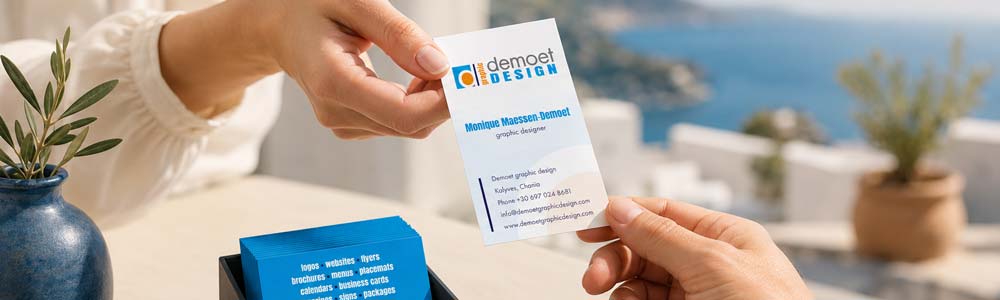
This is the question I get asked most, and the answer is pleasantly simple: a lot less than you think. At Demoet graphic design, designing a business card costs €75. That's the design (excluding printing) of front and back, based on your existing logo and brand identity, delivered print-ready. After that, you submit the file to the printer of your choice, or I arrange it for you through one of my regular printing partners.
For that amount, you get a card that fits exactly who you are as an entrepreneur, that looks like it's been well thought out, and that you can use for years. Compare it to what half a year of social media management costs, or a single ad in a trade magazine, and a good business card is one of the smallest investments with one of the longest shelf lives.
What's more: a business card is something you only have designed once. Printing costs a few tens of euros for a hundred pieces at a good printer. You pay the designer once. That design then lasts for years, as long as your brand identity doesn't change. Work it out over a few years: for less than a euro a month, you always have a professional representative of your business in your pocket.
What you get for €75
For €75 you don't get a template to choose from. You get a design made specifically for your business. I look at your brand identity, your sector, and what you want to express, and translate that into a card that suits you. Not an off-the-shelf solution, but something that's truly yours alone.
If you don't have a brand identity yet, a business card is actually a great reason to give that some proper thought. Because if you want to come across consistently to clients, you need more than just a card: you need a logo, color palette, and fonts that recur across all your materials. That's why I've also put together a starter package for new entrepreneurs. For €595 you'll have a logo and complete brand identity in hand right away, including a business card. That way you start off right from the beginning.
Are you wondering whether a full visual identity is worth the effort? In my blog post about logos and visual identities, and whether they are useful or essential for freelancers and SMEs, you can read why this often makes a real difference for small business owners.
How do you get the most out of your business card?
A good card lying at home in a drawer does nothing for you. The power lies in using it at the right moments. And by that I don't mean: leaving them everywhere and hoping someone picks one up. I mean: sharing them purposefully at moments when it matters.
Networking events and trade shows are the obvious opportunities. But also think of: when picking up an order from a client, during an introductory conversation at the table, when you're at someone's home for a quote discussion, or when you're standing in a shop talking to the owner who also happens to be an entrepreneur. All those moments are opportunities, and having a card on hand literally costs you nothing.
Also make sure you always have a stock on hand. Not ten, not fifty, but enough that you're not constantly thinking: "I really need to order new ones." A hundred pieces costs you about €35 to €40 at a printer (depending on the finish). That's a hundred moments where you can leave a professional impression. The numbers get more and more appealing the closer you look at them.
Distributing at the right moments
A client of mine had a new batch of flyers and business cards made for an event in her industry. She brought 200 along and thought she'd never get through them. She called me the next day: by the end of day 1, they were already gone.
That's no coincidence. A professional card draws attention, people take it with them, and sometimes even pass it on to others. It also pays to always carry a few cards in your bag or inside pocket. You never know where a conversation might lead. I know an entrepreneur who also carries his cards when visiting suppliers, because that's exactly where you sometimes meet the best contacts. Preparation isn't an exaggerated measure, it's just smart business.
Frequently asked questions about having a business card designed
How long does it take to have a business card designed?
In most cases, I deliver the design within a week, depending on how quickly we arrive at a final version together.
Can I also have a business card designed without an existing corporate identity?
Yes, that’s possible. I can help you think through the colors, fonts, and overall look and feel. If you don’t have a logo or visual identity yet, the starter package is often a smarter choice.
Does Demoet graphic design also handle the printing?
That’s possible. You can supply the print-ready file yourself to a printer of your choice, or I can arrange it for you through one of my regular printing partners.
What is the difference between a business card and a QR code on my phone?
A business card is tangible and stays with the recipient, without requiring them to take immediate digital action. A QR code is a handy addition, but it does not replace that physical interaction.
Conclusion why it works having a business card made
A business card is a small thing, but it tells a big story. It says that you've thought about who you are as an entrepreneur, that you take the details seriously, and that you find it worthwhile to make a good impression. In a world full of online stimuli, that tangible first point of contact is sometimes exactly what makes the difference.
Whether you're just starting out as a freelancer or have been in business for years: a well-designed business card is one of the smartest small investments you can make. Not because it's required. But because it simply works. For €75 you get something that keeps working for you for years, even when you're not nearby.
Are you interested in a business card?
Want a professional business card that truly fits you? Check out my graphic design services at the graphic design page or feel free to contact me directly (0031 6 4821 6537). I'm happy to help.
More blogs
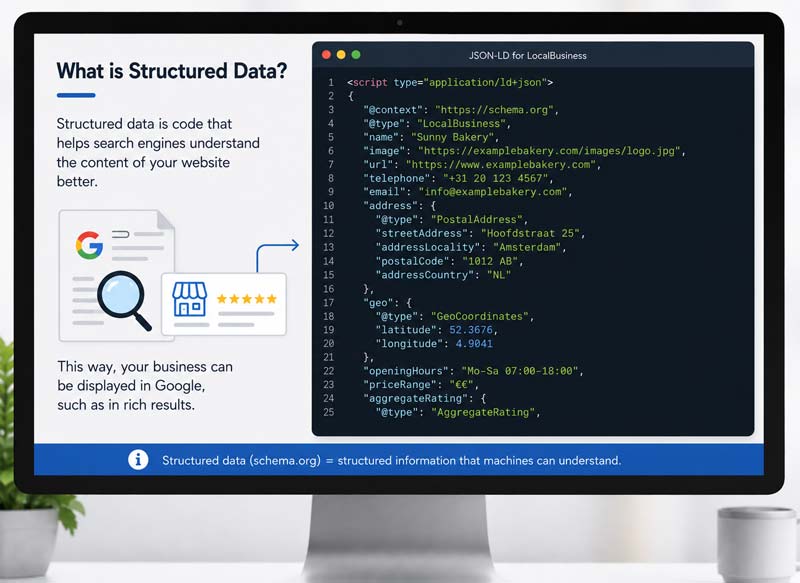
The importance of structured data on your website
Structured data tells Google and AI tools like ChatGPT who you are and what you do. Without this code your website often gets skipped in AI answers, even when the content itself is fine.
How to migrate from Divi 4 to Divi 5
Divi 5 had its official release on February 26, 2026. Divi 4 stays supported until at least the end of February 2027. Read the full step-by-step guide for a safe migration without stress.
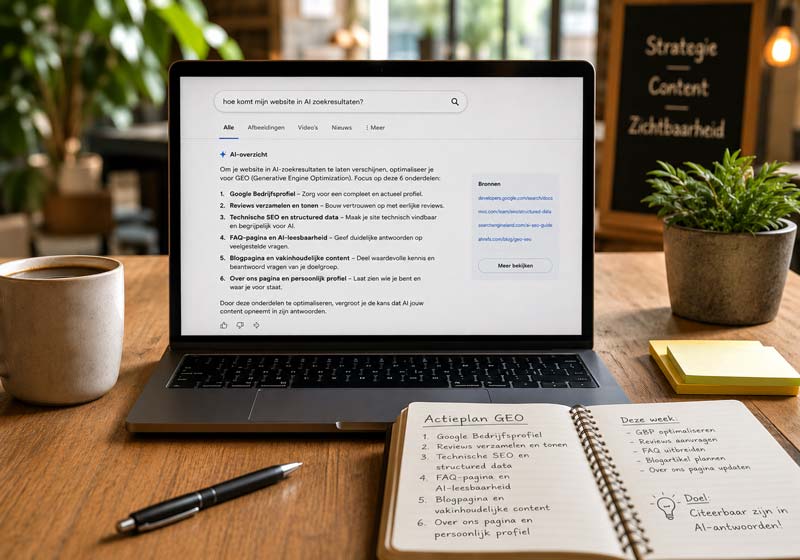
How do I get my website into AI search results?
GEO, Generative Engine Optimization, makes your website readable for ChatGPT and Google AI. These 6 components decide whether AI mentions your business as the answer to a customer’s question.
Share this blog?